New Delhi, October 24, 2026: Bank of India (BOI) has signed an agreement with the Centre for Development of Advanced Computing (C-DAC) to explore quantum-safe technologies for protecting banking data and artificial intelligence (AI)-based fraud detection systems. The partnership will focus on research, testing and potential banking applications rather than the immediate deployment of new security systems.
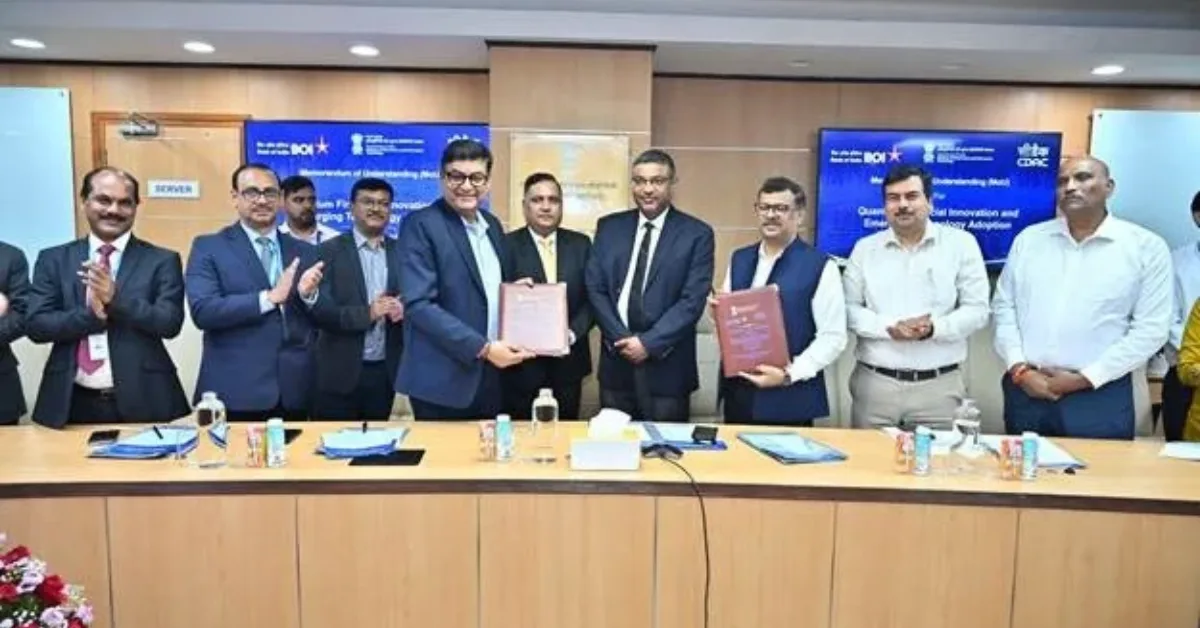
The Memorandum of Understanding (MoU), signed on October 22, establishes a framework for joint research, technology demonstrations, proofs of concept and training programmes.
According to the Ministry of Electronics and Information Technology (MeitY), the collaboration will combine C-DAC’s expertise in quantum computing, artificial intelligence, blockchain, cybersecurity and high-performance computing with Bank of India’s operational experience and technology infrastructure.
A key objective is to explore the development of a Quantum Ecosystem for Financial Innovation to help prepare banking systems for emerging opportunities and cybersecurity challenges associated with quantum technologies.
Quantum-safe technologies are designed to protect sensitive digital information against potential security threats arising from advances in quantum computing. Such technologies could become increasingly important as future quantum computers may threaten certain encryption methods used to secure financial data and digital transactions.
Under the agreement, Bank of India and C-DAC will identify suitable banking applications, explore proofs of concept in secure sandbox environments and assess their technical feasibility.
These controlled testing environments will allow the organisations to evaluate emerging technologies before deciding whether to proceed with pilot projects or wider adoption.
The partnership will also examine quantum-inspired technologies and assess their potential applications in banking operations.
Beyond quantum security, the collaboration will cover artificial intelligence, blockchain and other advanced computing technologies.
Potential applications include AI-assisted fraud analysis, credit and financial analytics, intelligent document processing, digital identity verification, secure data sharing and AI-powered assistance for customers and bank employees.
The organisations will also explore responsible AI systems, smart contracts and secure AI platforms for financial services.
However, these remain areas of proposed research and evaluation. The announcement does not confirm that Bank of India has deployed a new AI-based fraud detection platform or quantum-safe banking system.
MeitY Secretary S. Krishnan highlighted the importance of preparing India’s banking infrastructure for emerging cybersecurity risks associated with quantum technologies.
C-DAC Director General E. Magesh said the partnership would support the application of India’s indigenous quantum computing and emerging technology capabilities to banking services.
Bank of India Executive Director Rajiv Mishra highlighted the potential role of quantum technologies in strengthening cybersecurity and supporting complex financial decision-making.
The agreement also provides for training and capacity-building programmes covering quantum computing, quantum security, artificial intelligence, blockchain and related technologies.
The MoU was exchanged by Aditya Kumar Sinha, Executive Director of C-DAC Mumbai, and Satyendra Singh, Bank of India’s Chief General Manager (IT) and Chief Information Officer, in the presence of senior officials.
The ministry’s announcement does not disclose the financial value of the collaboration, a dedicated implementation budget or a confirmed timeline for deploying the proposed technologies in live banking operations.
The agreement represents an initial research and technology development partnership, with future deployment dependent on testing, technical assessments and subsequent implementation decisions.
Read also: India, Poland target doubling trade by 2030, propose defence industry dialogue