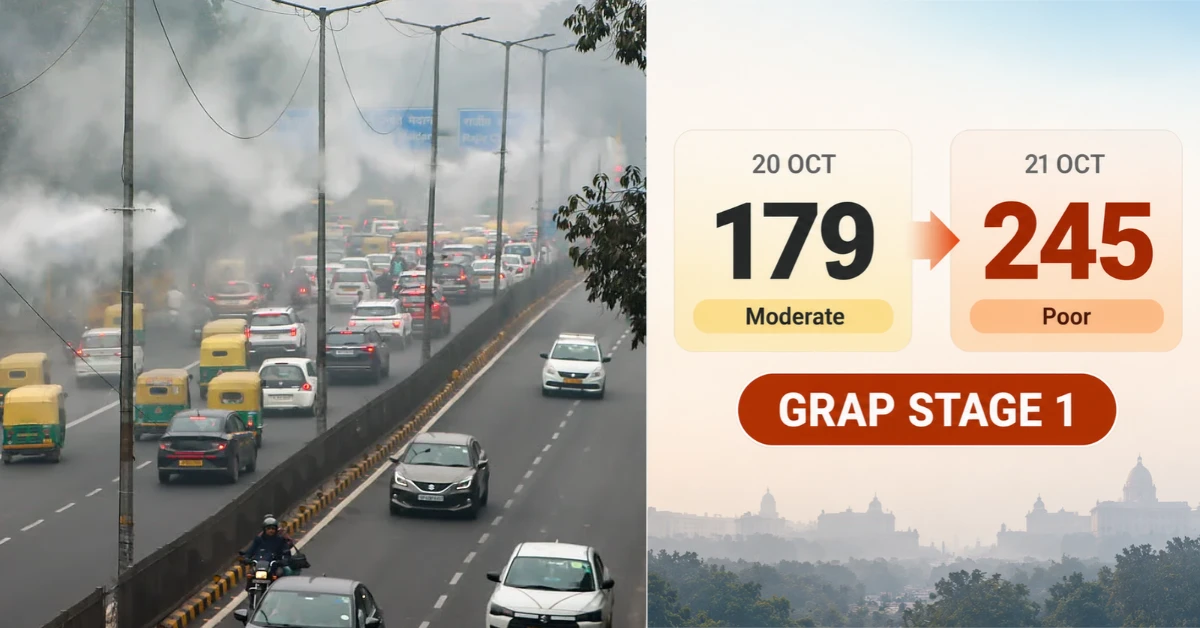
New Delhi, October 22, 2026: Delhi’s Air Quality Index (AQI) rose sharply from 179 on October 20 to 245 on October 21, prompting the Commission for Air Quality Management (CAQM) to enforce Stage 1 of the Graded Response Action Plan (GRAP) across the National Capital Region (NCR). The measures include stricter checks on construction dust, polluting vehicles, waste burning, industrial emissions and diesel generator use.
According to the Ministry of Environment, Forest and Climate Change, Delhi’s AQI stood at 179 in the ‘Moderate’ category on October 20 before rising to 244 at 2 pm on October 21. It reached 245 at 4 pm, placing the city’s air quality in the ‘Poor’ category.
Following a review of pollution levels and weather forecasts from the India Meteorological Department (IMD) and the Indian Institute of Tropical Meteorology (IITM), CAQM’s GRAP Sub-Committee invoked all 25 action points under Stage 1 with immediate effect on October 21.
The measures apply across the NCR and are intended to prevent further deterioration in air quality.
Under Stage 1, authorities have been directed to intensify inspections at construction and demolition sites to ensure compliance with dust-control requirements.
Construction materials and debris must be properly covered, while dust-generating activities must follow the prescribed mitigation measures. Agencies will also increase mechanised road sweeping, water sprinkling and the use of anti-smog guns where required.
Construction and demolition projects with plot areas of 500 square metres or more must comply with applicable registration and dust-control requirements. Projects that fail to meet the prescribed conditions may be prevented from carrying out the affected activities.
However, Stage 1 does not impose a blanket ban on construction work across Delhi-NCR.
Authorities will also strengthen enforcement against open burning of municipal waste and biomass, illegal waste dumping and pollution from landfill sites.
Vehicle-related measures include stricter checks on Pollution Under Control (PUC) certificates, action against visibly polluting vehicles and enforcement of existing restrictions on overage petrol and diesel vehicles.
Trucks not destined for Delhi will continue to be diverted through the Eastern and Western Peripheral Expressways under the applicable regulations.
The action plan also restricts specified inter-city and interstate bus services operating in Delhi-NCR from Haryana, Uttar Pradesh, Rajasthan, Punjab, Himachal Pradesh, Madhya Pradesh, Uttarakhand and Jammu and Kashmir.
Under the prescribed rules, electric, CNG and BS-VI-compliant diesel buses are permitted. The provision does not amount to a ban on all interstate bus services.
Industrial units, brick kilns, hot-mix plants and thermal power plants will face stricter monitoring to ensure compliance with emission standards and approved fuel requirements.
Authorities will also enforce existing restrictions on the use of coal and firewood in tandoors at hotels, restaurants and open eateries.
Diesel generator sets cannot be used as a regular source of power supply. Their operation remains subject to capacity-specific emission-control requirements, permitted exemptions and existing CAQM directions.
The Stage 1 measures do not impose a blanket ban on diesel generators.
To reduce traffic-related pollution, agencies have been asked to improve traffic management at congestion points and strengthen public transport services, including CNG and electric buses, Metro services and the Regional Rapid Transit System (RRTS).
Residents have been advised to use public transport, avoid unnecessary engine idling, maintain valid PUC certificates and refrain from burning waste.
Citizens can report pollution-related violations through platforms such as the SAMEER app, Green Delhi app and 311 app.
CAQM said the measures will be implemented, monitored and reviewed by the agencies concerned across the NCR. The commission will continue to assess air quality and weather forecasts to determine whether further restrictions are necessary.
The announcement invokes only Stage 1 of GRAP, which applies when the AQI falls within the ‘Poor’ category of 201–300.
It does not announce general school closures, a region-wide suspension of construction activity or other restrictions associated with higher GRAP stages.