New Delhi, October 16, 2026: The government has launched the National Strategic Trade Command Centre (NSTCC) to monitor India’s exports and imports, identify new opportunities for Indian exporters and track delays in trade-related applications. The platform is designed to help officials identify administrative bottlenecks and make quicker decisions, although it has not yet been demonstrated that the system can speed up approvals.
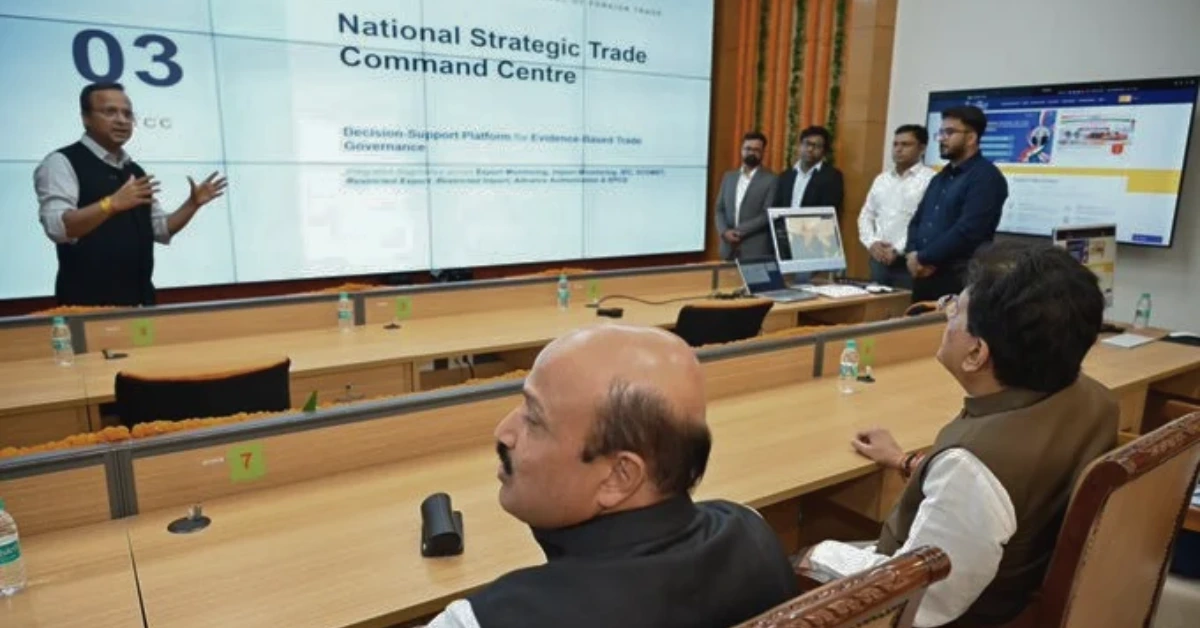
Union Commerce and Industry Minister Piyush Goyal inaugurated the command centre at Vanijya Bhawan in New Delhi on October 15, in the presence of Commerce Secretary Rajesh Agrawal and Director General of Foreign Trade (DGFT) Lav Agarwal.
Developed by the Department of Commerce, the NSTCC brings together information from existing trade-related digital systems through centralised dashboards. It will help authorised officials monitor export performance, regulatory applications, processing timelines and the use of government trade schemes.
The platform is also intended to support detailed analysis of India’s trade with different countries and across product categories. This could help policymakers identify potential export markets, assess the use of trade agreements and explore opportunities to increase Indian exports.
For businesses dealing with trade-related approvals, the system could improve administrative oversight by highlighting pending applications and processing delays. However, the NSTCC is a monitoring and decision-support platform rather than a separate authority responsible for approving applications.
During the inauguration, Goyal reviewed the dashboard for Special Chemicals, Organisms, Materials, Equipment and Technologies (SCOMET), a category covering sensitive goods and technologies subject to export controls.
He called for regular meetings of the Inter-Ministerial Committee, including weekly meetings if necessary, to address the backlog of pending SCOMET applications and expedite their processing.
The ministry did not disclose the number of pending applications or announce a specific deadline for clearing the backlog.
In its initial phase, the command centre includes dashboards covering Importer Exporter Code (IEC), Advance Authorisation, Export Promotion Capital Goods (EPCG), Certificates of Origin, SCOMET and restricted imports and exports.
These dashboards are intended to help officials monitor application processing, export obligations, scheme utilisation and performance across DGFT regional offices.
According to the Ministry of Commerce and Industry, the NSTCC builds on existing digital infrastructure, including DGFT systems and the Trade Connect ePlatform, rather than replacing those services.
The government plans to expand the platform in phases by integrating additional data from government departments and trade-related agencies. Future developments are expected to include automated alerts and more advanced analytical tools.
Access is also expected to expand gradually to authorised stakeholders, including relevant ministries, state governments, Export Promotion Councils and other institutions. The announcement does not indicate that the command centre is currently open to all exporters or the general public.
The initiative aims to strengthen government oversight of trade performance and regulatory processes by making relevant information more accessible to decision-makers.
Although the platform could help officials address processing delays and identify emerging export opportunities, its impact on approval timelines and India’s export performance will depend on how effectively it is implemented and used.
Read also: India’s exports jump $58 billion in six months, yet faster import growth pushes trade deficit higher