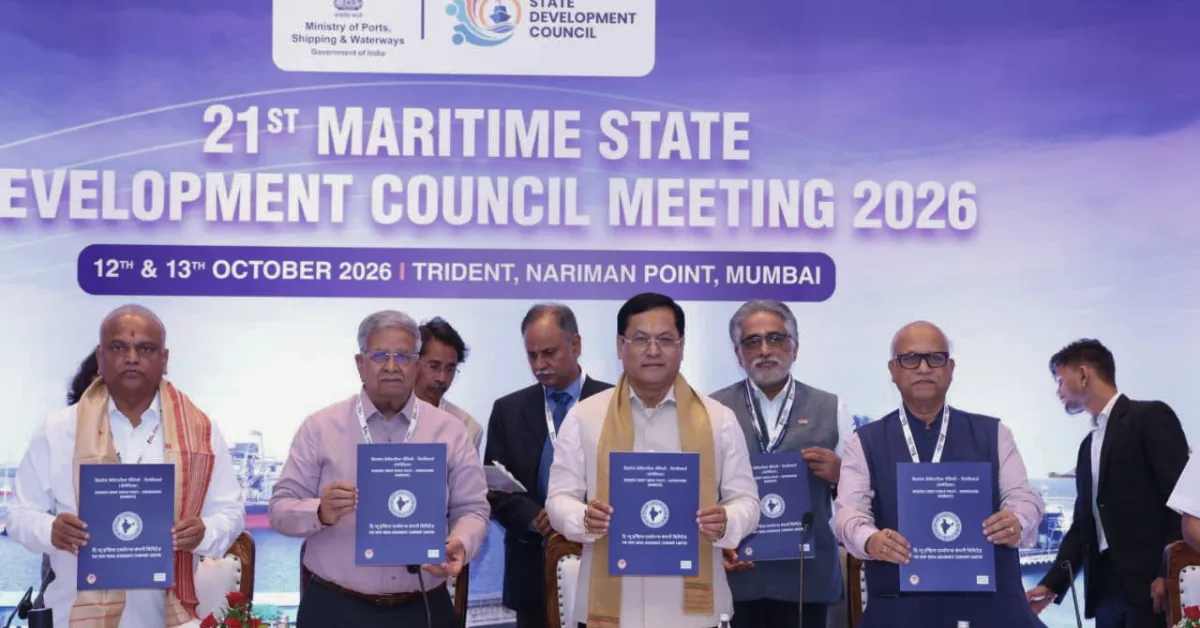
New Delhi, October 14, 2026: The Centre has launched two credit-risk insurance products to help Indian shipbuilders manage financial risks from delayed or missed payments, while setting a March 2027 deadline for ports across the country to adopt common operating procedures and digital systems. The measures were announced at the 21st Maritime State Development Council (MSDC) meeting in Mumbai, chaired by Union Minister for Ports, Shipping and Waterways Sarbananda Sonowal.
The insurance products will support shipbuilding projects for domestic and export markets, where payment delays can disrupt construction and put financial pressure on shipyards. Meanwhile, the One Nation One Port Process (ONOP) reforms aim to simplify documentation, standardise port operations and improve transparency in port charges.
According to the Ministry of Ports, Shipping and Waterways, the two insurance products were introduced under the National Shipbuilding Mission and developed through the Shipbuilding Development Scheme.
The Shipbuilding Project Credit Risk Insurance Policy, developed by ECGC Limited, is intended for export-oriented shipbuilding projects. The Business Credit Shield Policy–Shipbuilders, developed by The New India Assurance Company Limited, is designed to provide credit-risk protection for domestic shipbuilding projects.
The government will subsidise insurance premiums and provide support to insurers in cases where shipyards file claims. Sonowal said even a single missed payment during a multi-year shipbuilding project could disrupt a shipyard’s operations, highlighting the need for financial protection.
Under the port reforms, all ports are to adopt common documentation and operating procedures and integrate with Sagar Setu, the government’s Maritime Single Window digital platform, by March 2027. The system is intended to make port-related processes more consistent and improve coordination between the authorities involved.
The Council also made electronic publication of port tariffs mandatory, allowing shipping companies and other businesses to access information about port charges more easily. Sonowal launched an implementation guide to help major and other ports adopt the new procedures.
Beyond these measures, the Council prioritised stronger road, rail and inland waterway links to ports, along with the development of port-linked industrial regions and shipbuilding, ship-repair and recycling clusters.
The meeting was the Council’s first since it received statutory recognition under the Indian Ports Act, 2025. It also adopted targets under Maritime India Vision 2030 and Maritime Amrit Kaal Vision 2047 to guide future development of India’s maritime sector.
Read also: Mumbai Airport Terminal 1B revamp to lift capacity 33% as Adani begins phased work from January 2027