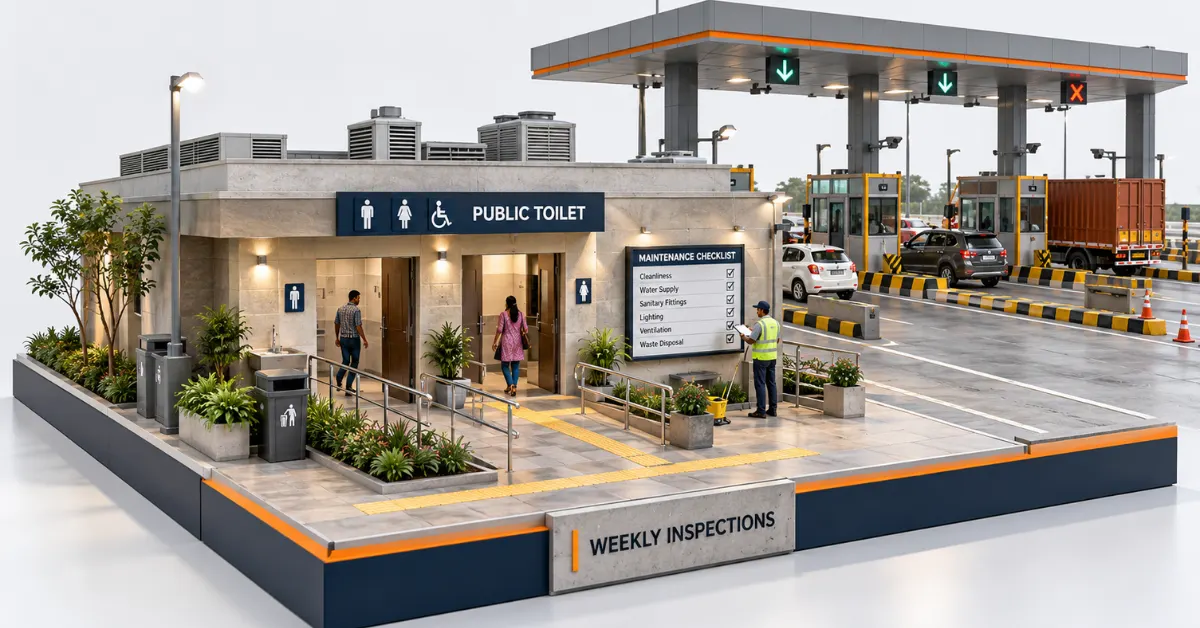
New Delhi, October 13, 2026: The National Highways Authority of India (NHAI) has introduced stricter inspections and enforcement measures to improve the cleanliness and maintenance of toilet facilities at toll plazas along national highways. Under the new system, agencies responsible for these facilities will face weekly inspections, penalties for contractual violations and possible restrictions on bidding for future NHAI contracts if they repeatedly fail to address maintenance problems.
According to the Ministry of Road Transport and Highways, the monitoring system will cover public toilets and other facilities at toll plazas, including toll collection booths, surrounding areas and signboards. The measures are intended to ensure that agencies maintain prescribed service standards and promptly address deficiencies identified during inspections.
NHAI officials will inspect the facilities at least once a week. If an inspection identifies a deficiency, the agency responsible will receive a show-cause notice and be directed to rectify the problem within a specified period. A show-cause notice requires the agency to explain the deficiency and respond to the authority before further action is taken.
To improve transparency and accountability, NHAI will upload notices and dated photographs of identified deficiencies to its Data Lake portal, a digital system used to maintain and monitor highway-related records. The agency concerned must submit its response and upload photographs showing the corrective action taken.
NHAI field offices will monitor whether the identified deficiencies have been rectified within the prescribed period. Agencies that fail to meet contractual obligations or service standards may face financial penalties in accordance with existing contract provisions and guidelines.
The new framework also provides for bidding restrictions against agencies that repeatedly fail to address maintenance problems. If the number of notices relating to unresolved deficiencies reaches or exceeds 10% of the total number of toll plazas operated by an agency, NHAI will classify it as a non-performer.
Agencies classified as non-performers will become ineligible to participate in bids for toll plaza operations, regular toll plaza contracts, civil works and other NHAI tenders for 15 days or until all pending deficiencies are rectified, under the mechanism announced by the authority.
The restrictions apply to user fee collection agencies operating publicly funded toll plazas and other toll plazas where such agencies have been appointed by NHAI. The inspection and enforcement measures will operate alongside existing contractual conditions and maintenance guidelines.
The initiative follows NHAI’s Clean Toilet Picture Challenge, introduced in 2025 to encourage highway users to report poorly maintained toilet facilities at toll plazas.
The challenge, which has been extended until June 30, 2027, allows travellers to report unclean toilets through the Rajmargyatra mobile app. Users must submit clear, geo-tagged and time-stamped photographs identifying the location and condition of the toilet.
Eligible reports can earn a ₹1,000 reward in the form of a FASTag recharge, subject to verification. Each vehicle registration number is eligible for only one reward during the scheme period, and the amount cannot be claimed as cash.
The scheme applies only to eligible toilets under NHAI jurisdiction. Toilets at petrol pumps, roadside eateries and other facilities outside NHAI’s control are not covered. Where multiple complaints are submitted about the same toilet on the same day, only the first valid report is considered for the reward.
While the Clean Toilet Picture Challenge allows highway users to report sanitation problems directly, the new monitoring system places greater responsibility on agencies operating and maintaining toll plaza facilities.
The Ministry of Road Transport and Highways said the combination of public reporting, weekly inspections, digital monitoring and contractual penalties is intended to improve accountability and ensure cleaner, better-maintained facilities for people travelling on national highways.
Read also: NHAI to cut diesel generator emissions on Dwarka Expressway as Delhi-NCR prepares for winter smog
Read also: India advances wildlife-sensitive highway planning as NHAI outlines new conservation measures