New Delhi: BRICS countries have called for faster and cheaper cross-border payments while advancing discussions on trade settlements and investments using local currencies, as the grouping also raised concerns over unilateral tariffs, sanctions and protectionist trade measures in the New Delhi Declaration 2026.
The declaration, adopted at the 18th BRICS Summit in New Delhi on September 12, sets out the grouping’s common position on trade, finance, energy, artificial intelligence, global governance, terrorism and ongoing geopolitical conflicts.
On trade, BRICS expressed concern over the growing use of unilateral tariff and non-tariff measures and protectionist actions that are inconsistent with World Trade Organization rules, warning that such measures could disrupt global trade and supply chains and increase economic uncertainty.
The grouping reaffirmed support for an open, transparent, fair and rules-based multilateral trading system centred on the WTO and called for reform of the organisation, including restoration of a fully functioning dispute-settlement mechanism.
BRICS also condemned unilateral economic and secondary sanctions that it considers inconsistent with international law and the United Nations Charter, highlighting their impact on international economic relations and developing economies.
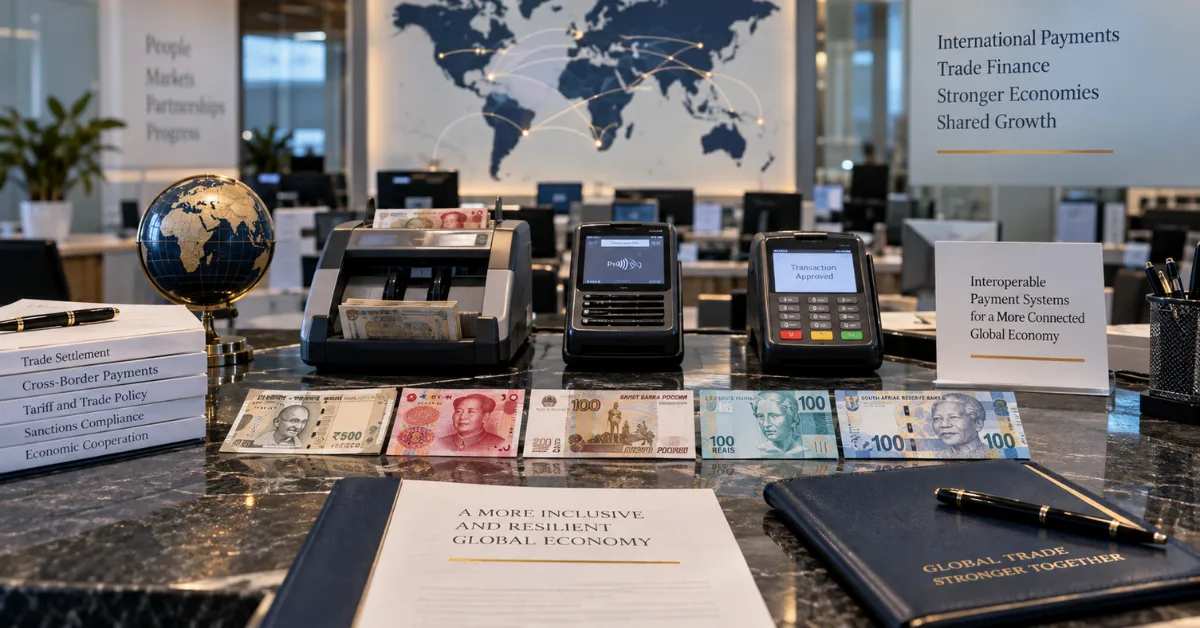
On financial cooperation, the declaration acknowledged ongoing discussions on promoting trade settlements and investments using BRICS local currencies, while recognising national priorities and noting that there is no one-size-fits-all approach.
It encouraged the BRICS Payment Task Force to continue developing practical solutions to improve cross-border payment interoperability, with the aim of making transactions faster, cheaper, more accessible, efficient, transparent and secure.
The declaration also encouraged the New Development Bank to expand local-currency financing and continue strengthening its role in infrastructure and sustainable development financing across member countries.
BRICS leaders also noted ongoing work on new financial mechanisms, including the proposed New Investment Platform, as the grouping explores ways to expand investment cooperation and capital mobilisation.
Energy security forms another major part of the declaration. BRICS called for a just, orderly, equitable and inclusive energy transition while recognising that fossil fuels will continue to play an important role, particularly in the energy systems of emerging markets and developing economies.
The grouping stressed the importance of stable and diversified energy markets, resilient supply chains and infrastructure, including cross-border energy connectivity, while supporting cooperation on energy-system digitalisation and critical minerals.
On artificial intelligence, BRICS recognised AI as an opportunity to support economic growth and sustainable development, while calling for international cooperation to ensure AI systems remain safe, secure, inclusive, trustworthy and accessible.
The declaration also highlights intellectual property considerations associated with AI, including the need to respect intellectual property rights and ensure fair remuneration for rights holders.
BRICS also renewed its call for reform of global governance institutions, including the United Nations Security Council, to increase the representation of developing countries.
China and Russia reiterated their support for the aspirations of Brazil and India to play a greater role in the United Nations, including its Security Council.
On terrorism, the declaration strongly condemned the April 22, 2025 terrorist attack in Jammu and Kashmir’s Pahalgam, in which 26 people were killed.
The grouping reiterated its call for zero tolerance towards terrorism and stressed the need to counter terrorist financing, safe havens and the cross-border movement of terrorists.
The leaders also expressed deep concern over the continued escalation of tensions in West Asia and called for maximum restraint, urging countries to avoid actions that could further aggravate the situation.
The declaration stressed the protection of civilians and civilian infrastructure and called for dialogue and diplomacy to achieve lasting peace and stability in the region.
The 140-paragraph New Delhi Declaration reflects an effort by the expanded BRICS grouping to establish common positions on global economic governance while deepening cooperation across payments, trade, finance, energy, technology, health and development.
Read also: RBI to sell ₹1 lakh crore government securities through three OMO auctions Beginning September 17
Read also: Cochin Shipyard starts construction of four green tugs for Svitzer under 2025 deal