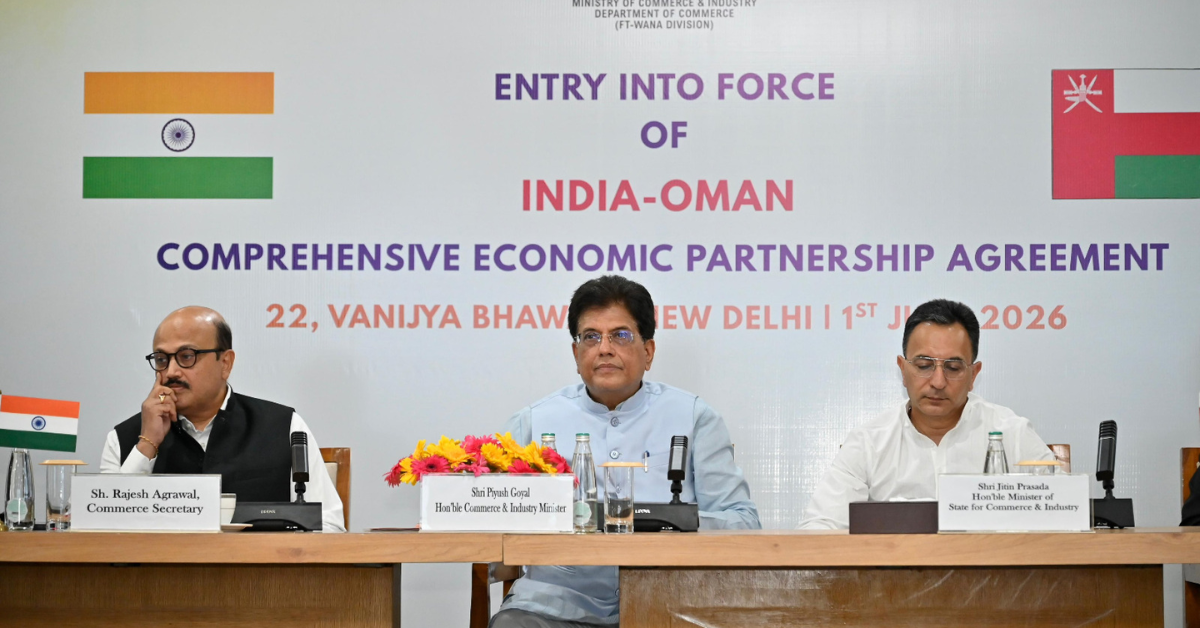
India expects at least two to three additional substantive Free Trade Agreements (FTAs) to come into effect within the next six months, Commerce and Industry Minister Piyush Goyal said on Thursday, 4 June, signalling an acceleration in the country’s trade integration efforts.
Speaking at the Citi India Conference 2026, Goyal said the recently operationalised Oman Free Trade Agreement, which came into effect on 1 June, is part of a broader push to expand India’s global trade footprint.
The minister said India is also likely to execute another three to four significant trade agreements over the coming year and operationalise all nine recently concluded trade agreements within the next nine to ten months.
Goyal highlighted that India has signed nine Free Trade Agreements over the past three to three-and-a-half years, covering 38 developed economies.
According to him, these agreements are expanding market access for Indian businesses, facilitating trade, enabling talent mobility and attracting investment into the country.
Read also: Southwest monsoon arrives in Kerala today, three days behind normal schedule
The minister said the agreements complement India’s economic growth strategy by helping Indian companies access new export markets while encouraging multinational firms to establish operations and Global Capability Centres in India.
Referring to recent engagements in Canada and the United States, Goyal said investor discussions reflected strong confidence in India’s economic prospects.
He noted that a proposed India-Canada Free Trade Agreement received a positive response during meetings with business leaders and investors.
The minister said India is increasingly being viewed as a trusted investment destination and a credible alternative manufacturing hub, supported by democratic institutions, a large consumer market, technological capabilities and policy stability.
Goyal also linked the expanding FTA network to the government’s broader efforts to improve the ease of doing business and attract long-term investment. He cited reforms such as the Jan Vishwas Act 2.0, which decriminalises nearly 1,000 offences across multiple central laws, and the recently announced Bhavya Scheme to develop 100 industrial parks with plug-and-play infrastructure.
According to the minister, India is positioning itself not only as a large consumer market but also as a centre for manufacturing, innovation, design and advanced technology, with trade agreements playing an increasingly important role in supporting that transition.