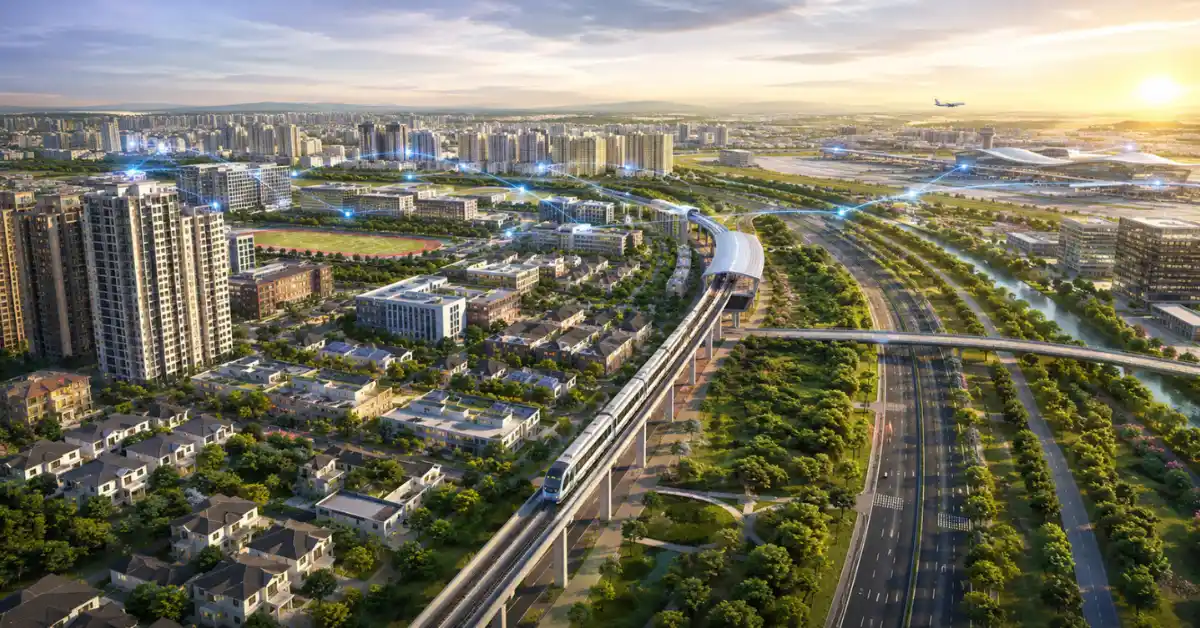
India’s middle class is expanding as rising incomes, lower taxes, cheaper loans, better housing access, wider healthcare coverage, metro and airport expansion, and digital public services reshape household spending and savings.
The scale of this shift is visible in the numbers. India’s middle class expanded at 6.3% annually between 1995 and 2021 and now accounts for about 31% of the country’s population, according to a PIB backgrounder released on Wednesday, 3 June.
OECD forecasts suggest India could overtake China in absolute middle-class population between 2030 and 2035, reflecting rising incomes, expanding economic opportunities and improving living standards.
The size of this group matters because middle-income households drive consumption while also investing in education, healthcare and housing, supporting entrepreneurship, contributing to tax revenues and creating demand for better public and private services.
The consumption shift is also expected to move beyond India’s largest metros.
The World Economic Forum has projected that 93% of India’s urban consumer growth is expected outside New Delhi, Kolkata, Mumbai, Bengaluru and Chennai, with nearly 500 “consumer cities” likely to emerge as incomes rise and the middle class expands.
WEF projections also suggest that by 2036, India’s middle class and affluent consumers will account for 93% of all spending, up from 80% in 2026.
A major part of this change is visible in household finances. In taxation, the zero-tax threshold has moved from income up to ₹2.5 lakh in 2014 to income up to ₹12 lakh under the new tax regime, or ₹12.75 lakh for salaried persons with standard deduction.
GST, introduced in July 2017, brought multiple central and state levies into a single indirect tax framework, while the taxpayer base increased from 66.5 lakh in 2017 to 1.64 crore by April 2026.
Financial security has expanded alongside tax changes. India is now the 10th largest insurance market globally by premium volume, and the share of insurance and pension funds in household finances rose from 28.6% in FY 2018-19 to 29.6% in FY 2024-25.
Government-backed schemes have widened the safety net, with 26.88 crore enrolments under Pradhan Mantri Jeevan Jyoti Bima Yojana, 57.11 crore enrolments under Pradhan Mantri Suraksha Bima Yojana and 43.52 crore health cards enabled under Ayushman Bharat Pradhan Mantri Jan Arogya Yojana.
Lower borrowing costs have also affected major household decisions.
Home loan rates declined from 9.5-10.5% in 2015 to around 7.35-8.75% in 2025, while personal loan rates fell from 14.25% in 2014 to 12.5% in 2026 and education loan rates declined from 14.25% to 9.4%.
These changes are linked to household spending on homes, education and personal needs.
Housing access has expanded with lower borrowing costs and public housing support.
Under Pradhan Mantri Awas Yojana-Urban, 125.31 lakh houses have been sanctioned and 98.1 lakh completed or delivered to beneficiaries as of May 2026.
The SWAMIH fund has separately supported stalled affordable and mid-income housing projects, completing over 58,000 homes across 146 projects since 2019.
Urban mobility has become another marker of changing middle-class life.
India now has the world’s third-largest metro network, with cities having metro services rising from five in 2014 to 26 in 2025 and daily ridership rising from 28 lakh in 2013-14 to more than 1.15 crore.
Rail and air connectivity have also expanded, with budgetary support for Indian Railways rising from ₹32,000 crore in 2014-15 to ₹2.78 lakh crore in FY 2025-26, and operational airports increasing from 74 in 2014 to 165 in 2026.
Basic amenities have improved household convenience across urban and rural areas.
Tap water connections increased from 3.23 crore in 2019 to 15.85 crore in May 2026, while waste processing in urban India rose from nearly negligible levels in 2014 to about 97% in 2026.
Electricity access has also become more reliable, with energy shortages declining from 4.2% in FY 2013-14 to 0.03% in FY 2025-26 and per capita electricity consumption rising from 957 kWh in 2013-14 to 1,460 kWh in 2024-25.
Healthcare affordability has changed through cheaper medicines and wider public health infrastructure.
More than 18,000 Jan Aushadhi Kendras now supply generic medicines at 50-80% lower prices, with Janaushadhi products helping save ₹40,000 crore in out-of-pocket medicine expenses over the past 11 years.
At the primary care level, 1,85,555 Ayushman Arogya Mandirs were operational as of 28 April 2026, recording cumulative footfall of more than 540 crore and over 60 crore screenings for oral, breast and cervical cancers.
Education and skilling have widened career pathways. The number of IITs increased from 16 in 2014 to 23 by 2025, while student strength doubled from 65,000 to 1.35 lakh over the past decade.
Skill programmes have also expanded job-linked training, with 27.74 lakh candidates trained under PMKVY 4.0 as of March 2026, 36.48 lakh beneficiaries under Jan Shikshan Sansthan and 54.41 lakh apprentices engaged through the National Apprenticeship Promotion Scheme.
The growth of startups has widened the role of the middle class from job-seekers to job-creators.
Under Startup India, recognised startups increased from 502 in 2016 to more than 2.23 lakh by March 2026, generating 23.3 lakh direct jobs.
Digital governance has changed how households access money, identity documents and public services.
Jan Dhan accounts increased from 14.72 crore in 2015 to 58.26 crore as of May 2026, while deposits rose from ₹15,670 crore in March 2015 to ₹3.01 lakh crore by May 2026. More than 144 crore Aadhaar numbers had been generated as of May 2026, and over 2,707 crore authentication transactions were carried out in 2024-25.
DigiLocker had 69.9 crore users as of 2 June 2026, compared with 9.98 lakh sign-ups in 2015, with more than 950 crore documents issued by May 2026.
The expansion of India’s middle class is therefore not limited to income growth alone.
It is linked to lower tax burden, cheaper credit, wider formal finance, housing access, mobility, healthcare, education, entrepreneurship and digital delivery of services.
For the economy, this matters because a larger and more confident middle class can support stronger consumption, higher savings, greater entrepreneurship and wider demand for quality infrastructure and services.
Note: The figures are drawn from a Ministry of Information and Broadcasting backgrounder released on Wednesday, 3 June, which compiled data from government ministries, the World Bank, OECD, WEF and other cited sources.
Read also : PhysicsWallah fined ₹5 lakh, McAfee ₹1 lakh as CCPA cracks down on dark patterns