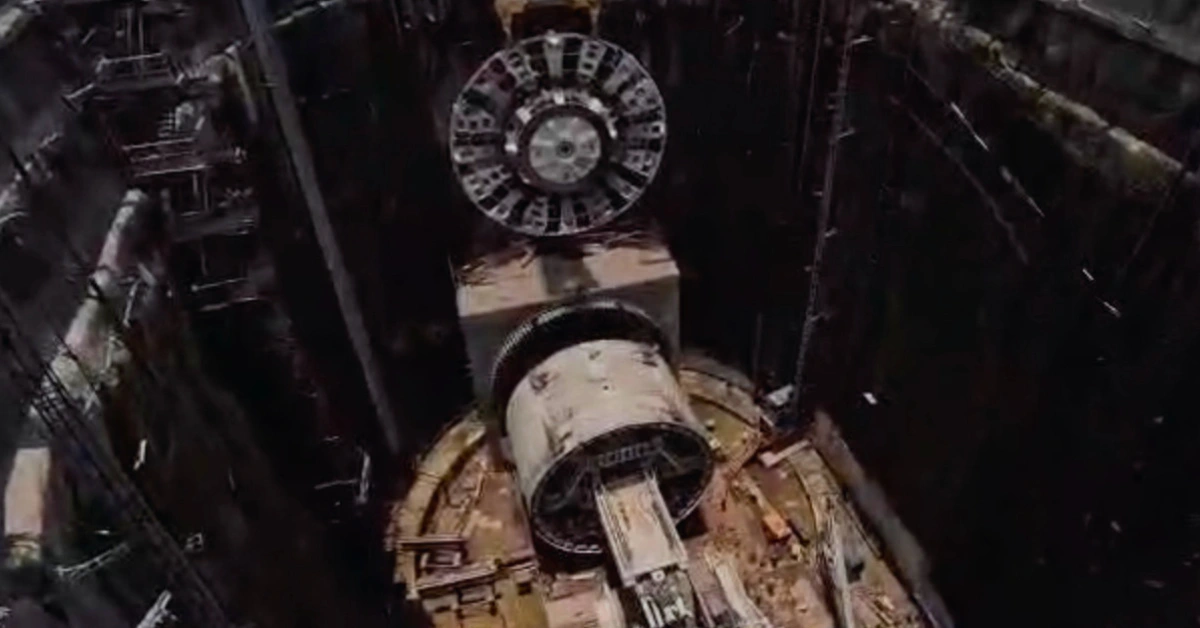
A 350-tonne cutterhead has been lowered at Vikhroli in Mumbai for the Mumbai-Ahmedabad Bullet Train project, marking a key step in the assembly of a Tunnel Boring Machine that will excavate part of the underground section in Maharashtra.
The Ministry of Railways said on Sunday, 17 May, that the first cutterhead of the TBM was lowered at the Vikhroli site. The component has a diameter of 13.6 metres and forms the final step in the primary assembly of the TBM’s main shield.
Two TBMs, each weighing more than 3,000 tonnes, are being assembled for the construction of a 16 Km portion of the 21 Km Mumbai tunnel. The underground section includes a 7 Km stretch below Thane Creek, which will be India’s first undersea rail tunnel.
According to the ministry, the machines are the largest ever deployed for rail tunnel construction in the country.
The cutterhead has been designed to excavate a single tunnel large enough to accommodate both the up and down lines of the high-speed rail corridor. Its 350-tonne weight is roughly equivalent to 250 passenger cars or midsize SUVs.
The unit reached the site in five separate shipments and was joined on location using 1,600 Kg of high-precision welding. It has been fitted with 84 cutter discs, 124 scrapers and 16 bucket lips to support excavation and muck removal.
The cutter discs will cut through the rock face, while scrapers mounted on the cutterhead will help clear muck from the face. The bucket lips will allow the excavated muck to enter the machine’s muck chamber, from where it will be directed into the removal system.
Read also : India’s first metro train with anti-drag door safety feature flagged off by Chennai Metro
The TBM assembled at Vikhroli will drive around 6 Km towards Bandra Kurla Complex. The route will pass below a dense urban landscape and the Mithi River before the machine is retrieved at the under-construction Mumbai Bullet Train station at BKC.
The 21 Km tunnel between BKC and Shilphata is among the most complex civil works on the Mumbai-Ahmedabad High-Speed Rail corridor.
5 Km of the tunnel has already been excavated using the New Austrian Tunnelling Method, while the remaining 16 Km is to be excavated through TBMs.
The ministry said several monitoring instruments are being used to support safe excavation and track the condition of nearby structures during tunnelling.
These include Surface Settlement Points, Optical Displacement Sensors or tilt meters, 3D targets, strain gauges for micro strains on the tunnel surface, seismographs for Peak Particle Velocity and instruments to monitor vibrations and seismic waves.
The Mumbai-Ahmedabad Bullet Train corridor is India’s first high-speed rail project.
The tunnelling work in Mumbai is critical because the alignment has to pass through built-up urban areas, river sections and the undersea stretch below Thane Creek.
Read also : Alwar station redevelopment gains pace as Railways launches ₹400 crore Rajasthan infra push