India and the United Arab Emirates have agreed to cooperate on setting up a ship repair cluster at Vadinar in Gujarat, with a separate pact also aimed at skill development in ship repair.
The agreements were concluded during Prime Minister Narendra Modi’s official visit to the UAE on Friday, 15 May 2026, where both countries reviewed their wider strategic partnership across energy, trade, investment, defence, security, infrastructure and people-to-people ties.
The main maritime agreement was signed between Cochin Shipyard Limited (CSL) and Drydocks World, Dubai, for cooperation in setting up a ship repair cluster at Vadinar, including offshore fabrication. The project will come under the Maritime Development Fund Scheme launched by the Government of India.
A second tripartite agreement was signed between CSL, Drydocks World and the Centre of Excellence in Maritime & Shipbuilding (CEMS) on skill development in ship repair.
According to an official statement, the agreement creates a framework to mobilise, train and employ a skilled maritime workforce.
It is also aimed at improving the capabilities of Indian maritime workers and positioning India as a hub for skilled shipbuilding and ship repair professionals.
The pact gives an international partnership layer to India’s planned ship repair expansion at Vadinar, where the Cabinet Committee on Economic Affairs had earlier in the month approved a new ship repair facility with a combined investment of ₹1,570 crore.
The Vadinar project will be jointly implemented by Deendayal Port Authority and Cochin Shipyard Limited.
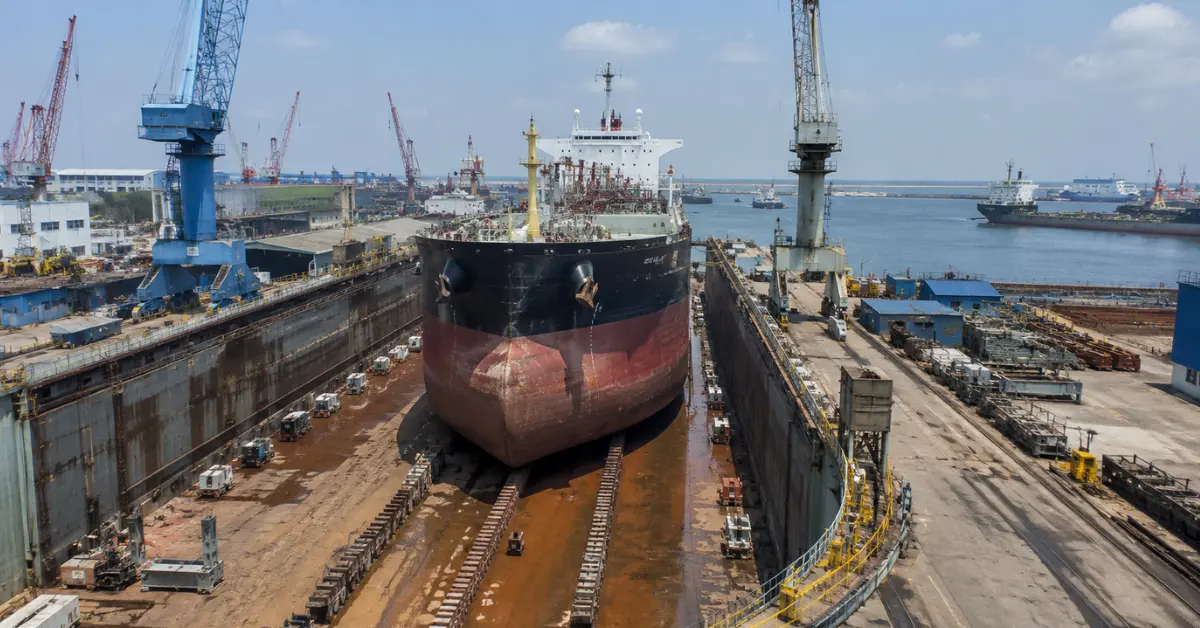
It is planned as a brownfield facility and will include a 650-metre jetty, two large floating dry docks, workshops and associated marine infrastructure.
The facility is expected to strengthen India’s domestic ship repair capacity, especially for large commercial vessels.
India currently lacks adequate domestic infrastructure to repair large vessels exceeding 230 metres in length, forcing many such vessels to seek repair support at overseas shipyards.
Once developed, the Vadinar facility will be capable of repairing vessels up to 300 metres in length. This is expected to allow high-value ship repair work to be carried out within India and reduce dependence on foreign repair facilities.
Read also : Nagpur Airport to be upgraded, modernised under PPP as Union Cabinet clears lease extension
Vadinar has been selected because of its natural deep draft, connectivity to major shipping routes and proximity to ports such as Mundra and Kandla.
These factors make the location suitable for repair operations involving large commercial and foreign-flagged vessels.
The government has said stronger ship repair capability on India’s western coast will improve turnaround time for vessels and enhance the competitiveness of Indian ports.
Apart from maritime infrastructure, the project is also expected to support ancillary industries, logistics, marine services and MSMEs linked to the ship repair ecosystem.
The Vadinar ship repair facility is estimated to generate around 290 direct jobs and nearly 1,100 indirect jobs across ship repair, logistics, marine services and associated sectors.
The ship repair cluster and skill development agreements also fit into India’s broader maritime infrastructure push under Maritime India Vision 2030 and Maritime Amrit Kaal Vision 2047.
During the visit, India and the UAE also concluded agreements in energy, defence, supercomputing and investment.
The two sides welcomed deeper bilateral cooperation and the operationalisation of a virtual trade corridor using MAITRI, a digital framework connecting customs and port authorities to improve cargo movement and reduce transit time.