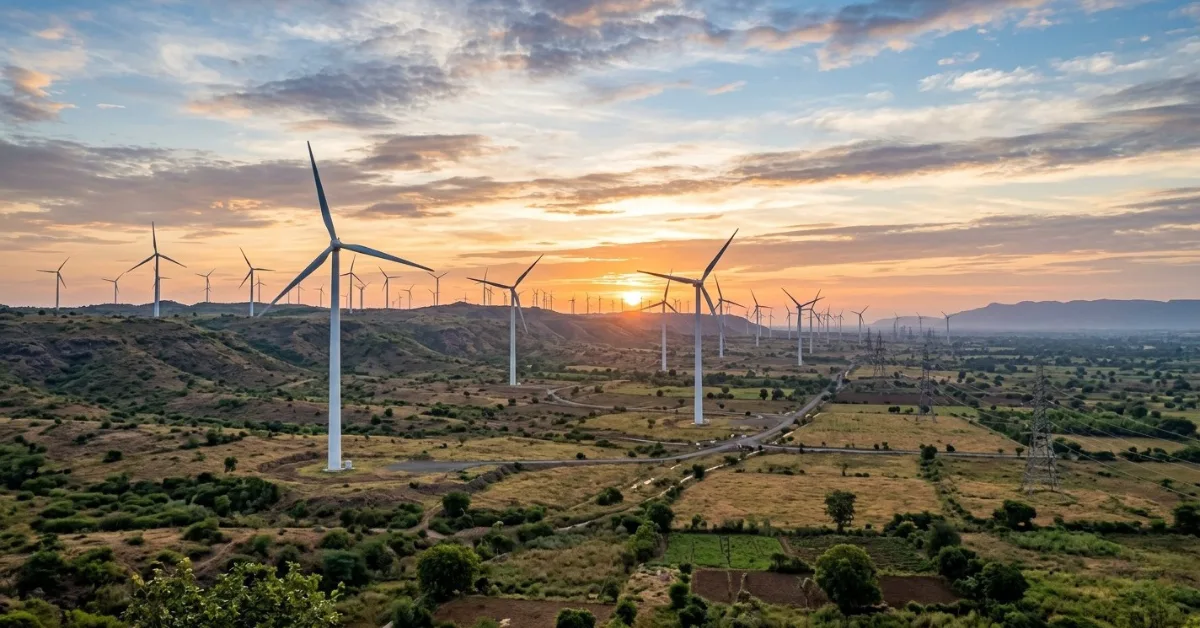
India added a record 6.1 GW of wind energy capacity during 2025-26, marking the highest annual addition in the sector to date, according to a statement by the Ministry of New and Renewable Energy.
The country’s cumulative installed wind capacity has now crossed 56.1 GW, placing India fourth globally in wind energy deployment.
An additional 28 GW of capacity is currently under implementation.
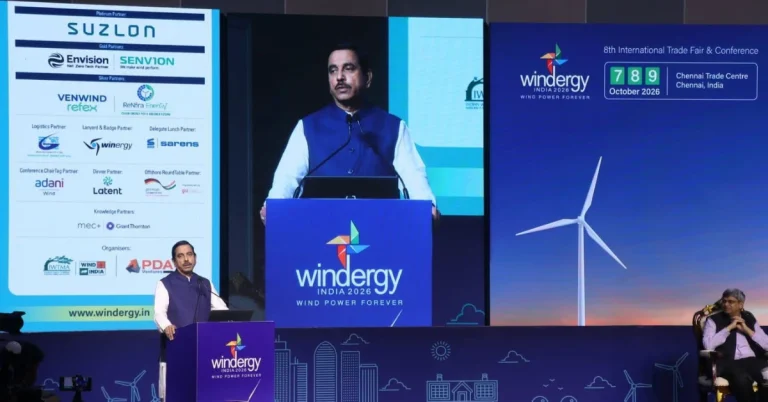
Addressing the Foundation Day of the Wind Independent Power Producers Association (WIPPA) on Wednesday, 22 April, Union Minister for New and Renewable Energy Pralhad Joshi stated that India’s wind energy potential at 150 metre hub height is estimated at nearly 1,164 GW.
The government has set targets of achieving 100 GW wind capacity by 2030 and 156 GW by 2036 as part of its long-term clean energy transition strategy aligned with the net-zero target for 2070.
Wind energy continues to play a critical role in balancing the power system, particularly due to its generation profile.
Around 45 per cent of wind power is produced during peak demand hours, especially in the evening and night, complementing solar energy generation.
On the policy front, the minister noted that the government has introduced a dedicated wind component under Renewable Purchase Obligations to sustain demand.
Additional measures such as enforcement of Late Payment Surcharge rules, transparent bidding frameworks, and implementation of the Approved List of Models and Manufacturers are aimed at strengthening investor confidence and supporting domestic manufacturing.
India has also developed a domestic manufacturing ecosystem for wind energy with an annual capacity exceeding 24 GW and indigenisation levels ranging between 70% and 80%.
The supply chain spans key components including blades, towers, and gearboxes.
The government is examining the release of additional wind tenders and is promoting hybrid and round-the-clock renewable energy projects to improve grid efficiency, according to the minister.
Issues related to deviation settlement penalties, curtailment, and transmission delays are under consideration.
Further initiatives include the Green Energy Open Access rules to enable direct procurement of renewable energy by industries, repowering of older wind turbines, and expansion of transmission infrastructure through the Green Energy Corridor programme.
To support financing, mechanisms such as blended finance and credit enhancement frameworks are being explored.
A 500 MW pilot project under the Contracts for Difference model has also been launched to provide revenue certainty and improve market stability.
The ministrer noted that evolving global supply chain dynamics present an opportunity for India to position itself as a key manufacturing and supply hub in the wind energy sector.
Read also: India’s installed power capacity reaches 532.74 GW; non-fossil sources account for 53.21%