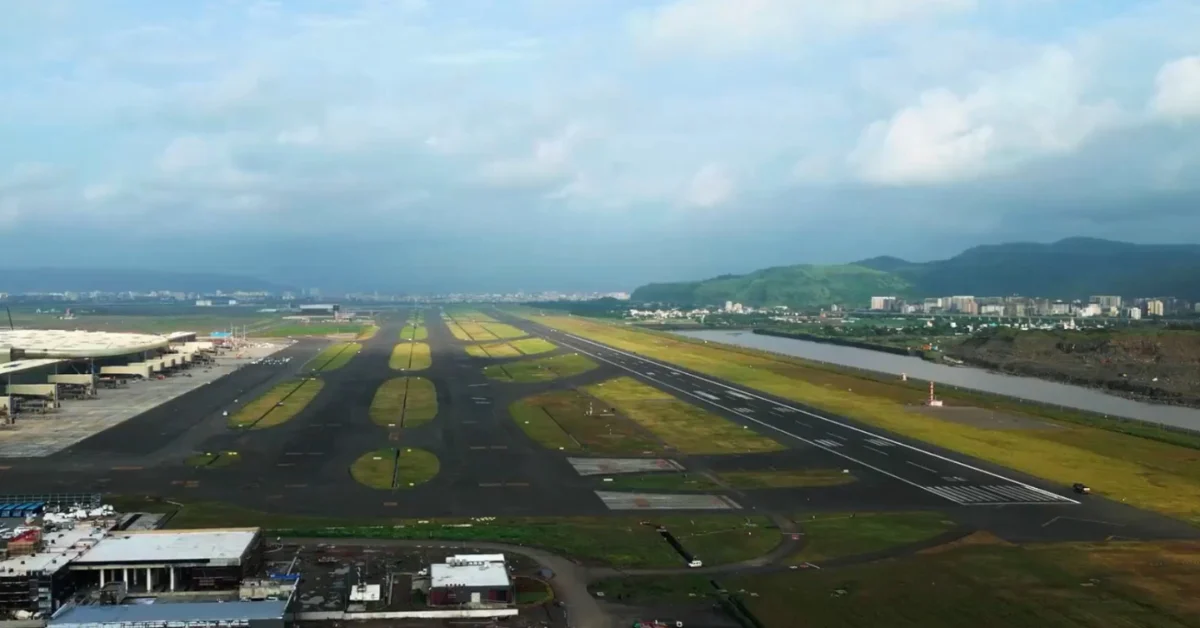
The City and Industrial Development Corporation (CIDCO) has begun the process for a techno-commercial feasibility study to examine the possibility of adding a third runway at the Navi Mumbai International Airport (NMIA), as part of efforts to address long-term aviation demand in the Mumbai Metropolitan Region.
CIDCO has appointed a Joint Venture (JV) of RITES Limited and Creative Group LLP as a consultant to undertake a Techno-Commercial Feasibility Study for the development of a third runway at NMIA.
The study is likely to be completed within six months.
In this regard, a key meeting on the Techno-Commercial Feasibility Study for the proposed third runway at Navi Mumbai International Airport was held under the chairmanship of CIDCO chairman and managing director Vijay Singhal on Wednesday, 15 April.
“The meeting focused on detailed discussions regarding various aspects of the study, for which a Joint Venture of RITES Limited and Creative Group LLP has been appointed as the consultant,” CIDCO said in a statement on X.
Phase I of NMIA was inaugurated by Prime Minister Narendra Modi on 8 October 2025, and the airport commenced commercial operations on 25 December 2025.
In its initial phases, the airport is operating with a single runway and terminal capable of handling 20 million passengers annually, before scaling up in later phases toward its larger long-term capacity.
Planned over 1,160 hectares, NMIA is designed to eventually handle 90 million passengers annually along with 3.2 million tonnes of cargo, with two parallel runways and four terminals to be developed in phases.
The airport is operating alongside the Chhatrapati Shivaji Maharaj International Airport, which is nearing its operational limits.
However, long-term projections suggest that even the combined capacity of the two airports may not be sufficient, according to a Hindustan Times report.
Passenger traffic demand in the Mumbai Metropolitan Region is estimated to reach around 150 million annually by 2040 and could rise further to about 240 million between 2047 and 2050, highlighting the need for early capacity planning.
Singhal underscored the forward-looking approach behind the move, noting that the NMIA is being envisioned as a major aviation hub rather than just a relief facility for Mumbai’s existing airport.
“This is not just about decongesting the existing airport. We are planning this as a long-term gateway for the region, and that requires us to think ahead in terms of capacity, efficiency and future expansion,” Singhal was quoted as saying by Hindustan Times.
The study will evaluate technical, operational, environmental and financial aspects of adding a third runway, along with its integration into the current airport layout.
If found feasible, the additional runway could enhance aircraft movement capacity, improve slot availability, and strengthen NMIA’s positioning as an international transit hub.