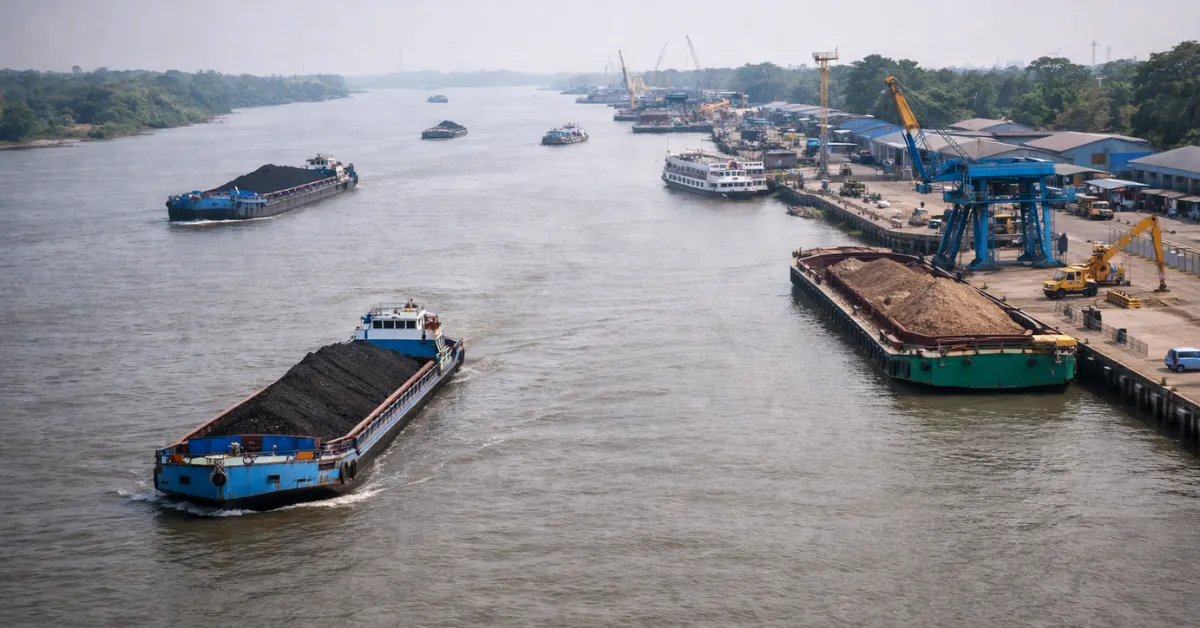
India’s inland water transport sector has expanded steadily over the past decade, with cargo and passenger movement rising sharply, according to the Economic Survey 2025-26.
As of November 2025, 32 National Waterways were operational, covering 5,155 km, the Survey said. Cargo services were active on 29 waterways, passenger services on 23, and cruise operations on 15, reflecting broader use of inland water routes across regions.
Cargo traffic on inland waterways increased from 18 million metric tonnes in 2013-14 to 146 million metric tonnes in 2024-25, the Survey showed. Passenger movement also rose, reaching 7.6 crore passengers in 2024-25, compared with 1.61 crore in 2023-24.
On National Waterway-1, the Survey said work under the Jal Marg Vikas Project, a Rs 4,600 crore programme covering 1,390 km between Varanasi and Haldia, is scheduled for completion by 30 June 2026. Cargo movement on this stretch increased by 220 per cent, from 5.05 million metric tonnes in 2014-15 to 16.38 million metric tonnes in 2024-25, following the development of multimodal terminals at Varanasi, Sahibganj and Haldia, and an inter-modal terminal at Kalughat.
The Survey said operational changes, including faster pontoon opening mechanisms and the construction of community jetties, have supported movement along the waterway. Fifty-three community jetties are currently operational on National Waterway-1.
River cruise services have expanded alongside cargo operations. The Survey said the number of cruise vessels increased from three in 2013-14 to 25 in 2024-25, operating across 15 circuits on 13 National Waterways in nine states. A 4,000 km Varanasi-Dibrugarh corridor, supported by 129 terminals, is operational, with additional terminals planned by 2027.
Read also : India’s Major Ports Handle 591.38 Million Tonnes Cargo In Apr-Nov 2025, Register 7.61 Per Cent Growth