Raksha Mantri Rajnath Singh has called upon the Defence Research and Development Organisation (DRDO) to move decisively beyond established and relatively low-risk technology domains, urging the organisation to take bold bets in areas where success is uncertain but strategically transformative.
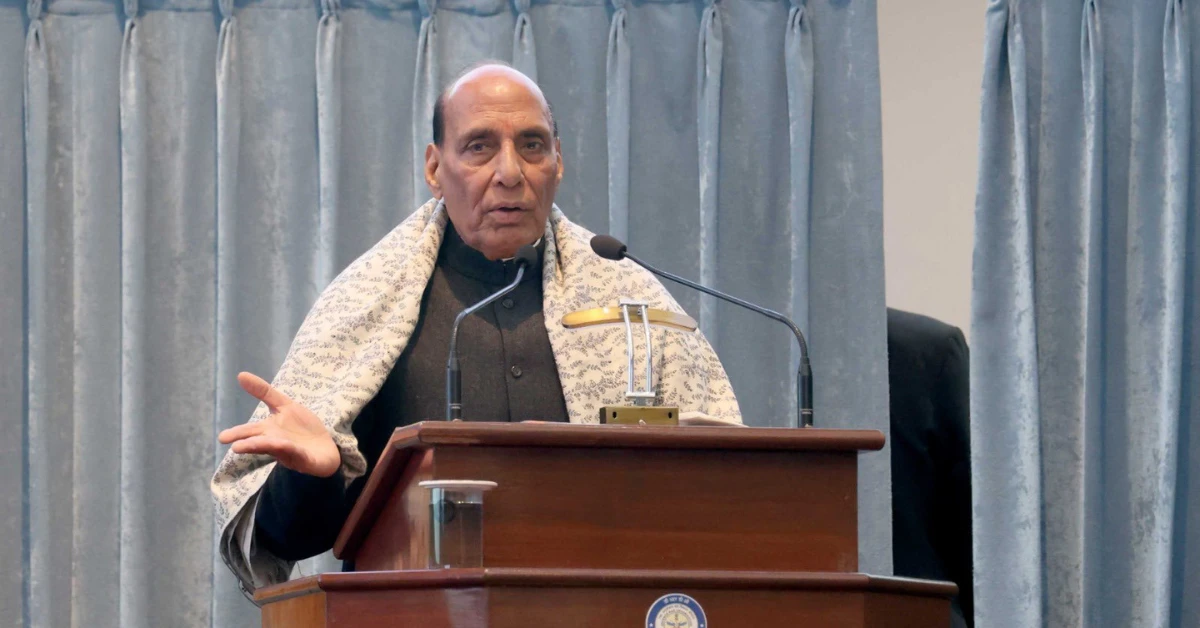
Addressing DRDO’s best performing scientists and technical personnel in New Delhi, Singh stressed that India’s premier defence research body must consciously operate in spaces where private industry is either unwilling or unable to invest due to high uncertainty.
He suggested the creation of a separate wing within DRDO dedicated exclusively to such high-risk research initiatives.
According to a statement by the Ministry of Defence, Singh urged the “DRDO to move beyond the sectors where the private sector has already developed its capabilities, suggesting the creation of a separate wing within the organisation that takes risks in sectors where the chances of success may seem low. However, if success is achieved, it will be historic”.
The Defence Minister warned that rapid technological change has drastically shortened the relevance cycle of defence systems, particularly in battlefield environments.
Emphasising speed over legacy strength, he underlined the need for faster innovation, decision-making and deployment.
“Technology is changing rapidly. Any tech that is new today may become irrelevant in 4-5 years. Therefore, in today’s times, especially on the battlefield, we must move forward keeping in mind the theory of ‘survival of the fastest’ and not just ‘survival of the fittest’,” Singh said.
Singh also highlighted persistent structural delays between research, prototyping, testing and induction, calling for a sharper focus on operational timelines.
“Timely induction in the Armed Forces should be the biggest parameter of our performance,” he asserted, pointing out that delays often undermine technological advantage before deployment.
While acknowledging DRDO’s traditional focus on design and prototyping, Singh emphasised the need to bridge the transition gap between laboratory innovation and large-scale production.
He advocated a co-development model aligned with international practices, where industry participation begins at early design stages rather than post-development.
Referring to recent operational experience, Singh said indigenous defence systems had proven their effectiveness during Operation Sindoor, reinforcing the growing role of domestic technologies in India’s operational readiness. “Operation Sindoor demonstrated that indigenous systems are strengthening India’s operational readiness,” he noted.
Calling for deeper collaboration across public sector undertakings, private industry, MSMEs, start-ups and academia, Singh said government support would be meaningful only if DRDO moved away from a monopolistic R&D approach towards a collaborative ecosystem.
He expressed confidence that a more agile, risk-embracing DRDO would play a critical role in building India’s long-term strategic autonomy and technological edge.